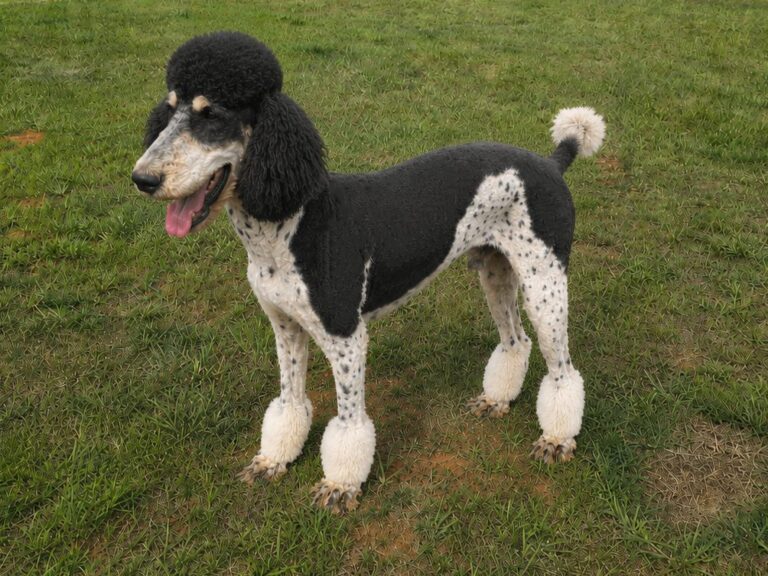
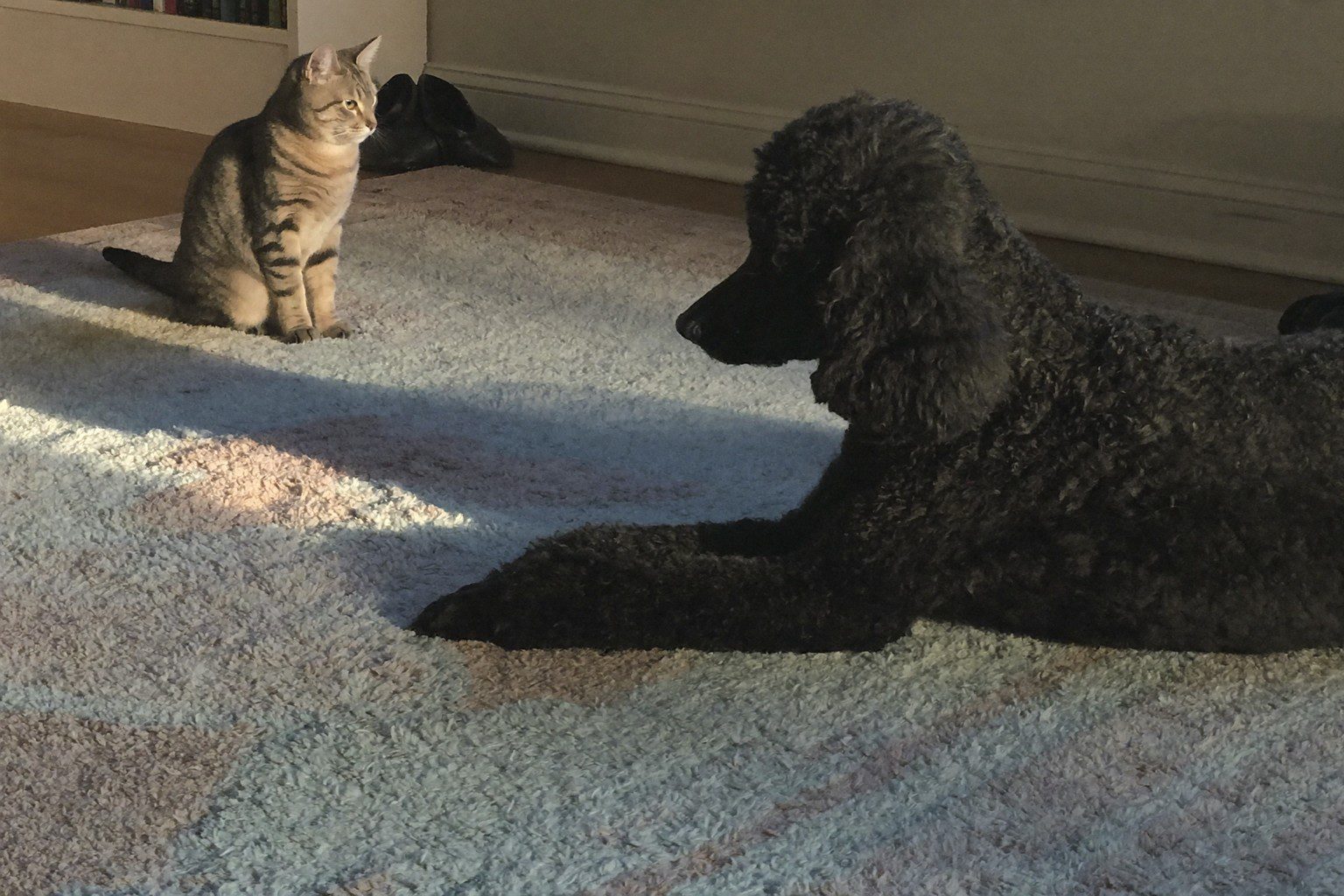
Standard Poodles generally do well with other animals. They are sociable by nature, they were bred to work cooperatively alongside people and other dogs, and they carry very little of the terrier-style drive to chase and kill small things.
“Generally” is doing some work in that sentence, though. Most of what determines whether your poodle lives peacefully with your cat is not the breed. It is how you handle the first two weeks.
The Retriever Thing Matters
The Poodle is a retrieving breed. The name comes from the German Pudel, meaning to splash in water, and the job was fetching downed waterfowl back to the hunter.
That history is relevant to how they treat other animals. A retriever’s instinct is to locate, pursue and carry back intact – not to catch and kill. It is a fundamentally different drive from a terrier’s, and it is why poodles tend to be safe around cats and small pets in a way that some breeds simply are not.
There is still a chase instinct. A cat that bolts will be followed, because a small fast thing moving away is interesting to almost every dog. The difference is what happens at the end of the chase, and with most poodles the answer is nothing much – they catch up, and then they have no idea what to do next.
That is not a guarantee, and it is not a reason to skip the work below. Individual dogs vary, and a chase that goes on long enough can escalate in any breed.
Introducing a Puppy to a Resident Cat
The good news is that a puppy is the easy version of this. An eight-week-old Standard Poodle is smaller than most adult cats and considerably less confident, and the usual outcome is a puppy who learns early that cats are in charge.
Do it in stages rather than all at once.
First few days: separate. Keep them apart entirely and let them get used to each other through a closed door. Swap bedding between them so each learns the other’s smell before ever seeing them.
Then: visual, controlled. A baby gate, or the puppy in his crate while the cat has the run of the room. Let the cat approach or not, entirely on her own terms. Do not hold the cat. Do not hold the cat up to the puppy. A restrained cat is a frightened cat and frightened cats make lasting decisions.
Then: same room, puppy on a leash. Short sessions. Reward the puppy for looking at the cat and then looking away, which is the behavior you actually want long term – noticing the cat and choosing to disengage. Do not reward staring, however calm it looks.
Then: supervised freedom, building up over a couple of weeks.
Two things the cat needs throughout, non-negotiably. Vertical escape routes – shelves, cat trees, cleared countertops – so she can always get above the dog. And a dog-free zone with her food, water and litter box behind a baby gate the puppy cannot pass. A cat who cannot eat or use a litter box without being pestered will start doing both somewhere else, and that is a much harder problem to unwind than the original introduction.
Let the cat correct the puppy. A swat on the nose from a resident cat teaches a lesson far more effectively than anything you can do, and it is how the relationship gets calibrated. Intervene only if the cat is genuinely cornered or the puppy will not back off.
Meeting Another Dog
If you already have a dog, introduce on neutral ground rather than in your house. A resident dog meeting a newcomer on its own territory is starting the relationship with a territorial dispute.
Walk them in parallel, a few feet apart, in the same direction, without letting them greet head-on. Head-on approaches are confrontational in dog language. Walking together in the same direction is not, and after ten or fifteen minutes of it most dogs have relaxed considerably.
Then home, with the resident dog’s toys, bed and food bowl picked up first. Most fights between dogs living together start over resources, and the simplest way to avoid resource guarding is to remove the resources at the start.
Feed separately, in different rooms or crates, permanently. This is not a phase to get through – it is just how a multi-dog household should run.
Protect your older dog, too. This is the most common mistake and the one that causes real conflict. An adult dog does not necessarily want a puppy climbing on it for fourteen hours a day, and a puppy who is never told to stop will keep going. Give the older dog a puppy-free space and use it before things get tense rather than after. Constant harassment turns a tolerant adult dog into an intolerant one.
Puppies also need to learn that adult dogs will correct them, and a growl or an air-snap from a well-adjusted adult dog is normal communication rather than aggression. Punishing an older dog for growling teaches it to skip the warning next time, which is genuinely dangerous.
Small Pets
Rabbits, guinea pigs, chickens, birds. Manageable with sensible precautions, but be realistic – these are prey-shaped animals and a dog is a predator, however friendly.
Never leave them unsupervised together, whatever the history. Secure housing that does not depend on the dog’s good behavior. And take seriously the fact that a small animal can die of stress from being stared at through a cage by a large dog, without ever being touched.
Standard Poodles and backyard chickens work out fine in plenty of households. They work out fine because of fencing and supervision, not because of trust.
When It Is Not Going Well
Signs to take seriously: fixed staring that will not break, stiff-bodied stillness, a cat that has stopped eating or has stopped using the litter box, hiding that lasts beyond the first week, or any actual snapping.
Slow down. Go back to separation and rebuild. Two weeks of careful work is much cheaper than a household where the animals have to be permanently kept apart.
If there is genuine aggression rather than clumsiness, get a qualified behaviorist involved early rather than waiting. Early intervention works. Waiting for it to settle on its own usually does not.
What We Can Tell You Before You Choose
Our puppies are raised in the house with our own dogs around them, so by the time they leave here at eight weeks they have already learned a good deal about reading other dogs – including being told off by adults, which is a useful education. That does not make them cat-proof. It does mean they arrive socially literate rather than starting from zero.
If you have a cat, another dog, or livestock, tell us on your adoption application. It genuinely affects which puppy we suggest. Within any litter there is a range from bold and pushy to soft and deferential, and a household with an elderly cat and a nervous older dog wants a very different puppy from a household with two teenagers and a Labrador.
That matching is one of the real advantages of buying from a small breeder who lives with the litter. Sharon and I watch these puppies daily from birth, and by eight weeks we know which one hangs back and which one is first through every door.
More on temperament in are Standard Poodles good family dogs, and on the breed generally in our poodle information section. Our current litters are on the current litters page, or call us in Morganton at 828-870-3989.
Ready to Find Your Perfect Standard Poodle?
Family-raised in Morganton, NC. Health-tested parents, a five-year guarantee, and AKC registration on every puppy.