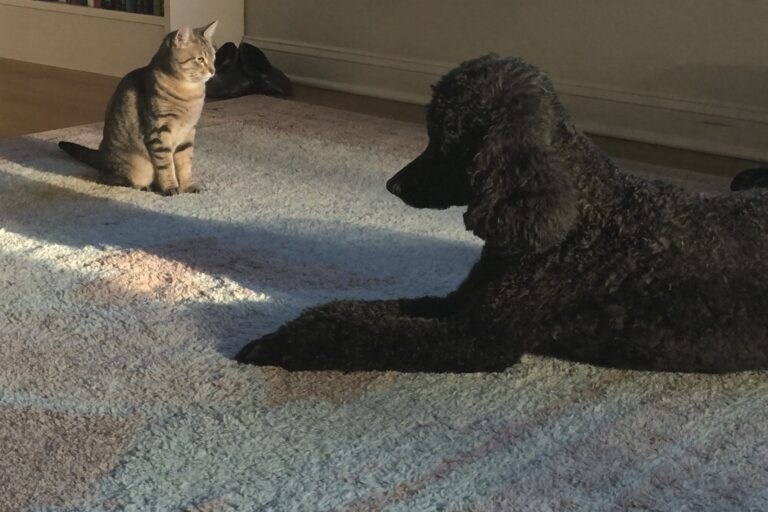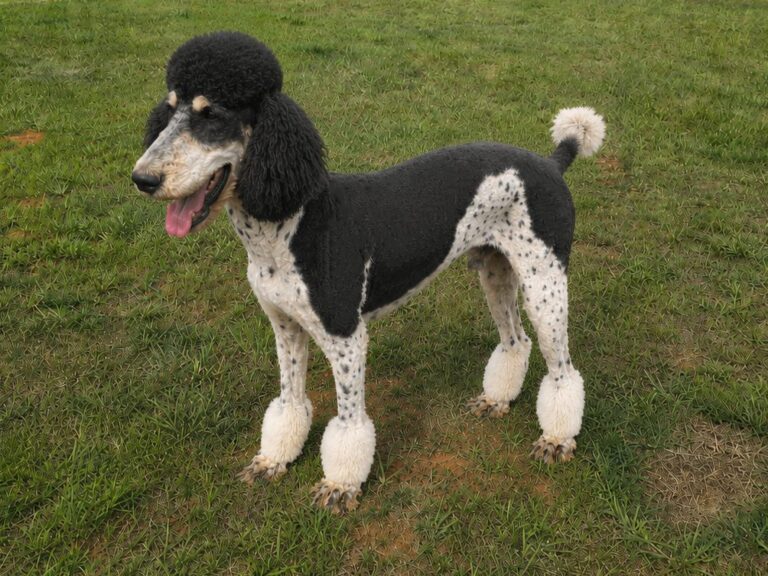
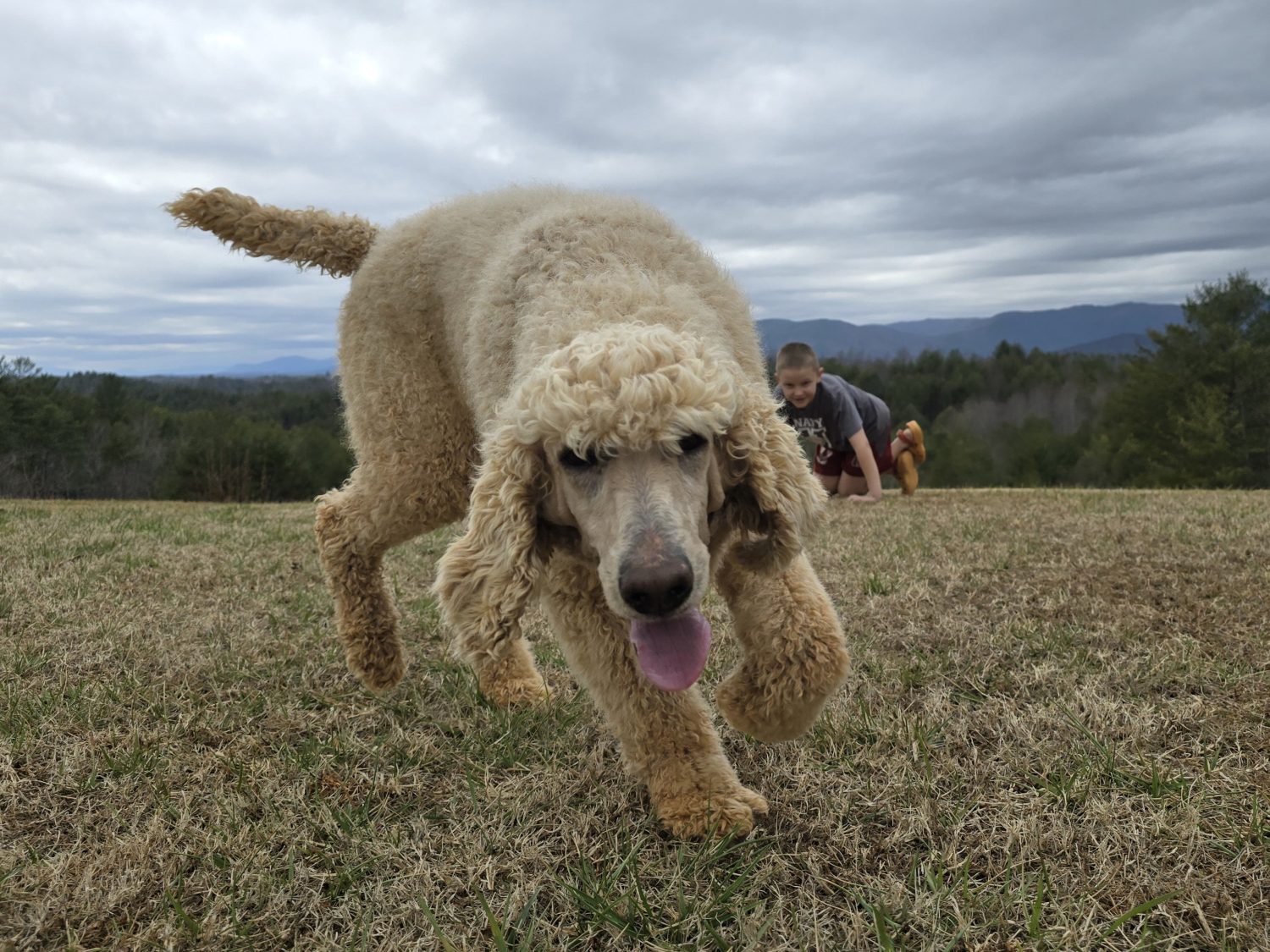
Standard Poodles are usually ranked among the two or three most trainable breeds in the world, and the ranking is deserved. They learn fast, they want to work with you, and they will pick up a new cue in a handful of repetitions.
What nobody mentions is that this cuts both ways. A dog that learns “sit” in five minutes learns “if I bark at the back door, a human opens it” in about the same time. Poodles are not learning only when you are teaching. They are always learning, and they are extremely good at noticing which of their own behaviors produce results.
So yes, easy to train. Also easy to accidentally train.
Months 2 to 4: The Window That Does Not Reopen
The socialization window closes somewhere around 14 to 16 weeks. That is not a training deadline, it is a developmental one – a window during which your puppy’s brain is unusually willing to file new experiences as normal rather than as threats.
What goes in during that window shapes the adult dog. What does not go in is much harder to add later, and in some cases never fully goes in at all.
So the priority in these weeks is not obedience. It is exposure. Men with beards, hats, umbrellas, wheelchairs, walking sticks. Children of different ages, including the loud unpredictable ones. Traffic, bicycles, motorcycles, tractors. Slippery floors, metal grates, stairs. Vacuum cleaners, hair dryers, thunderstorms.
Quality matters more than quantity. A puppy dragged into an overwhelming situation and made to endure it learns that new things are frightening – the opposite of the lesson. Let him observe from a distance he is comfortable with, let him approach on his own terms, pay him for being brave, and leave before he is overloaded.
The vaccination problem is real and gets handled badly in both directions. Your puppy is not fully covered until his shots are complete, and parvo is genuinely dangerous. But keeping a puppy in the house until sixteen weeks means missing the entire socialization window, and behavioral problems from under-socialization put more dogs in shelters than infectious disease does. The workable middle: carry him, use your own yard, visit friends with vaccinated adult dogs, avoid dog parks and public grass where unknown dogs have been. Ask your vet what makes sense locally.
Alongside that, keep training sessions to about five minutes. Name recognition, sit, a hand touch, and the beginnings of a recall. Short and frequent beats long and occasional at this age.
Months 4 to 6: Genuinely Easy
This is the golden stretch, and it is where families conclude they have an unusually gifted dog.
Your poodle is old enough to concentrate, still young enough to want to stay close to you, and not yet independent enough to have opinions. Sit, down, stay, leave it, loose-leash walking, a solid recall – most Standard Poodles will pick these up quickly and reliably.
Get to a group class if you can. Not because you cannot teach a sit at home, but because a class teaches your dog to work while other dogs exist nearby, which is a completely different skill and much harder to build later.
Teething runs through this period, roughly four to six months, and everything goes in the mouth. This is not defiance and it is not solved by correction. Provide appropriate things to chew, manage access to inappropriate ones, and wait it out.
Enjoy these months. Write down what he can do. You will want the evidence shortly.
Months 6 to 12: Adolescence, and Nobody Warns You
Around six months, a well-trained puppy will appear to forget everything he ever knew.
The recall stops working. He hears you and carries on. He tests things he settled months ago. Families arrive at this point convinced they have broken their dog, or that all the earlier training was somehow fake.
It was not. This is adolescence – a real neurological and hormonal reorganization, well documented in dogs, and it looks a great deal like the human version. The dog is not being spiteful. His brain is being rebuilt around him.
What gets people through it:
- Go back to a long line. Every recall your dog ignores makes the next one weaker. A 30-foot line means he never gets to practice ignoring you. This is not a step backward, it is protecting the thing you spent months building.
- Raise the pay. Whatever worked at four months will not compete with the outside world now. Use the good stuff – chicken, cheese – for recall specifically.
- Manage rather than argue. If he cannot be trusted somewhere, do not take him there yet. Winning a confrontation is worth less than avoiding one.
- Exercise him properly. An under-exercised adolescent poodle is not a training problem, it is an energy problem wearing a training problem’s clothes. See how much exercise a Standard Poodle needs.
- Keep going. It resolves, usually somewhere between 12 and 18 months, and what emerges is the dog you were building all along.
Crate behavior often comes apart in this same window, incidentally, and for the same reason. Our crate training plan covers rebuilding it.
What Makes Poodles Different to Train
They get bored. Drill a sit twenty times and a poodle will start offering variations to see if something else pays better. That is not disobedience, it is a bored problem-solver. Keep sessions short, vary them, and stop while he still wants more.
They are sensitive. Harsh handling works badly on this breed. A poodle that is intimidated shuts down and stops offering behavior at all, which is the worst possible outcome in a dog you are trying to teach. Reward-based training is not a soft option here, it is the method that actually works.
They read you closely. Poodles are unusually good at picking up on human body language and mood, which is lovely when you are calm and a problem when you are frustrated. If a session is going badly, stop. Your dog already knows it is going badly.
They need a job. This breed was developed as a water retriever, not a lap dog, and the working brain is still there. A Standard Poodle with nothing to do will invent something, and you will not like it. Puzzle feeders, scent games, trick training, a proper walk with things to sniff. Fifteen minutes of nose work tires a poodle more than an hour of fetch.
The Honest Verdict
Easy to train, harder to live with than the ranking suggests.
The intelligence that makes them quick to learn also makes them quick to notice inconsistency, quick to get bored, and quick to work out exactly which family member gives in. A Standard Poodle in a household that is inconsistent will be running the household within a month, entirely pleasantly, and nobody will quite be able to say when it happened.
If you want a dog you can teach almost anything to, this is the breed. If you want a dog that needs no mental engagement, it is emphatically not.
Where We Start Them
Training does not begin at pickup. It begins in the first days of life, and that part is our job.
Our puppies go through early neurological stimulation in their first two weeks – brief, structured handling that research associates with better stress tolerance later. They are raised in our house rather than a kennel building, so household noise is already normal by the time they leave. And they are handled daily by Sharon and me from birth, so a human reaching for them is unremarkable.
Everything after eight weeks is yours. What we can hand you is a puppy who starts from a good place.
You can meet the parents behind our litters on our dogs page, and temperament is covered further in are Standard Poodles good family dogs. Questions about a particular puppy’s temperament are always worth asking – call us at 828-870-3989, or start with the adoption application.
Ready to Find Your Perfect Standard Poodle?
Family-raised in Morganton, NC. Health-tested parents, a five-year guarantee, and AKC registration on every puppy.