This is the article we most hope you never need, and the one we most want you to read anyway.
Bloat kills healthy dogs. Not old dogs, not sick dogs – a dog that was fine at dinner can be in serious trouble by bedtime and dead by morning. It is one of the few genuine emergencies in veterinary medicine where the time between recognizing it and reaching help changes the outcome directly.
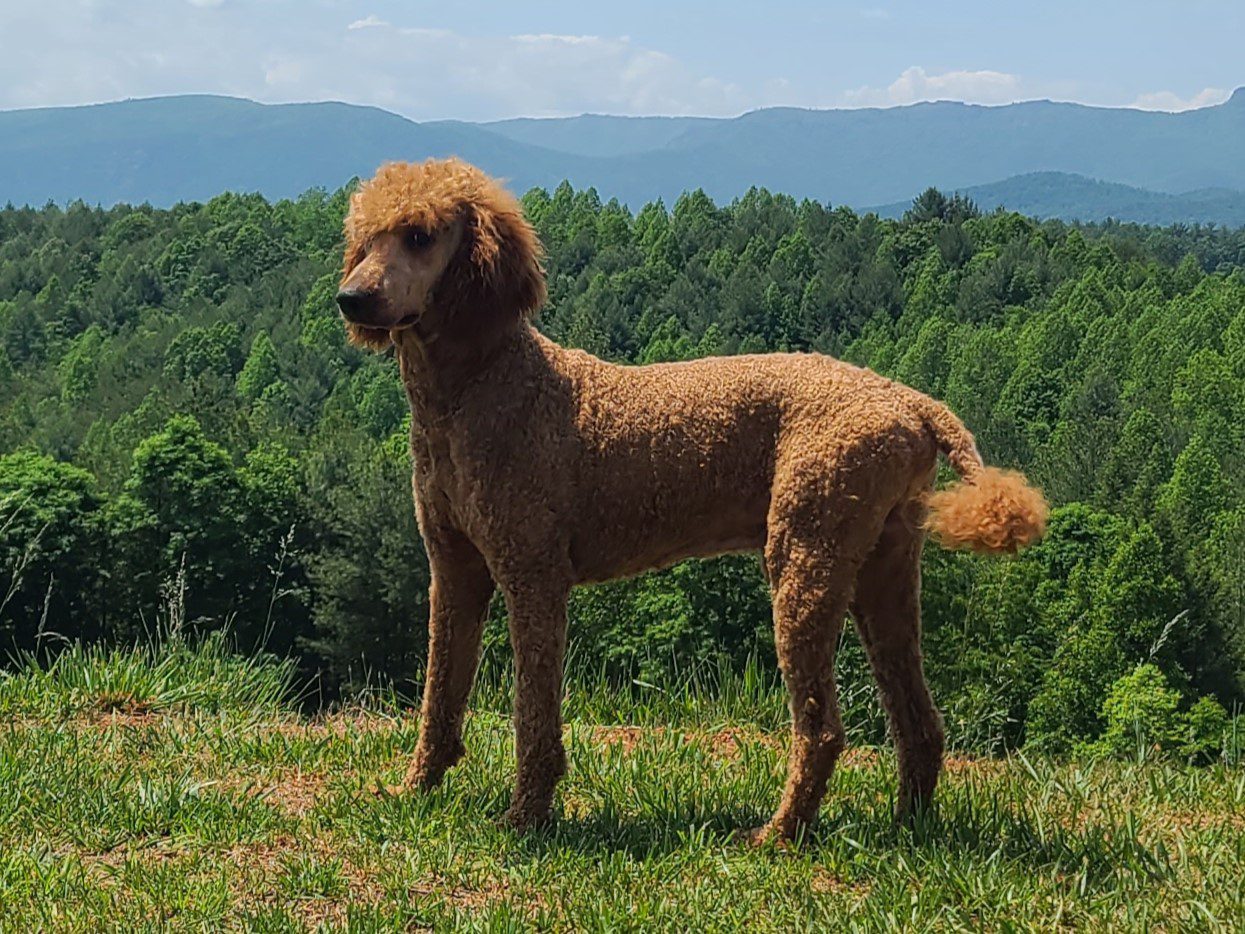
Standard Poodles are a deep-chested breed, and deep-chested breeds are the ones at risk. So please read this before you need it, because the middle of it is not when you want to be reading anything.
What Bloat Actually Is
Two things, and they usually happen in sequence.
First the stomach fills with gas and distends. That alone is uncomfortable and serious. Then, in the dangerous version, the distended stomach rotates on itself – a volvulus – sealing off both the entrance and the exit. Gas that is already in cannot escape, and more keeps being produced.
From there it moves fast. The swelling stomach presses on major blood vessels and cuts off circulation back to the heart. Blood supply to the stomach wall itself is choked off and the tissue starts to die. The dog goes into shock. Without surgery, this is usually fatal, and often within hours.
The full name is gastric dilatation-volvulus, usually shortened to GDV. Deep-chested breeds are predisposed because of the shape of the ribcage and the room it gives the stomach to move.
What You Would Actually See
The single most recognizable sign is unproductive retching. Your dog looks like he is trying hard to vomit and nothing comes up, or only a little foam or saliva. He tries again. Still nothing.
A dog that vomits and produces vomit is doing something fairly ordinary. A dog that repeatedly tries to vomit and cannot is showing you a sign that should get you moving.
Alongside that:
- A swollen, hard belly, particularly behind the ribs on the left. It can feel taut, like a drum. On a poodle in full coat this is easier to feel than to see, which is why you use your hands.
- Restlessness and pacing. He cannot settle. He lies down, gets up, tries somewhere else. This is often the very first sign, before anything is visibly wrong, and it is frequently dismissed.
- Drooling, often heavily, because he cannot swallow past the twist.
- Standing in unusual postures – front end down, back end up, or elbows out and neck extended, trying to find a position that relieves the pressure.
- Pale gums. Lift the lip. They should be pink. White, gray or muddy means circulatory shock.
- Rapid shallow breathing, a racing heart, weakness, collapse. These are late signs.
You do not need all of these. Unproductive retching plus a distended belly plus restlessness is enough. Do not wait to collect the full set.
What to Do
Go to a veterinarian immediately. Do not wait to see if it improves. It does not improve.
Call ahead while someone else gets the dog into the car, and say the words “I think my dog has bloat.” That phrase means something specific to every veterinary team and it changes how they prepare – they will have a table and staff ready when you arrive rather than working through triage.
If it is outside normal hours, go straight to an emergency hospital rather than waiting for your regular practice to open. Find your nearest 24-hour emergency vet now, while nothing is wrong, and put the number in your phone. Ten minutes of searching at eleven at night is ten minutes you do not have.
Do not try to treat this at home. Do not induce vomiting. Do not attempt to relieve the pressure yourself with anything you have read about online. Do not offer food or water. There is no home remedy for a twisted stomach, and every minute spent trying one is a minute of lost circulation.
Treated promptly, survival rates are good. Treated late, they fall sharply. That is the whole reason this article exists.
Reducing the Risk
You cannot eliminate it. You can shift the odds.
- Feed two or three smaller meals rather than one large one. A single big daily meal is associated with higher risk, and splitting the food costs nothing.
- No hard exercise for an hour either side of eating. This is the rule most commonly broken – the after-dinner run in the yard.
- Slow down a fast eater. A dog that inhales its food swallows a great deal of air with it. A slow-feeder bowl or a large object in the bowl to eat around both work.
- Do not let him gulp large volumes of water at once, particularly after exercise. Offer smaller amounts more often.
- Keep stress down around meals. In multi-dog households, competitive eating means faster eating. Feed separately, which is good practice anyway.
The raised-bowl question comes up constantly and the honest answer is that the evidence is mixed and has shifted over the years. Some research has associated raised feeders with increased risk in large breeds, which is the opposite of the advice many owners were given a decade ago. Ask your own vet rather than treating it as settled.
Preventive Gastropexy
Worth knowing about, and worth a conversation with your vet rather than a decision made from an article.
A gastropexy is a surgical procedure that tacks the stomach wall to the abdominal wall so it cannot rotate. It does not prevent the stomach from filling with gas, but it largely prevents the twist – which is the part that kills.
It is commonly done at the same time as a spay or neuter, since the dog is already anesthetized and the abdomen is already open, which makes it far less of an undertaking than a separate operation. For a deep-chested breed this is a reasonable thing to raise with your vet at the spay or neuter consultation. Our health guarantee asks that puppies be spayed or neutered before 18 months, so that conversation will happen anyway – it is worth adding this question to it.
We are not telling you to do it. We are telling you to ask, because a lot of owners never hear about it until after an emergency.
Please Do Not Panic About This
Having read all that, some perspective is fair.
Most Standard Poodles never bloat. This is not something to spend a decade worrying about, and it should not put you off a wonderful breed. Deep-chested dogs live long, healthy, ordinary lives every day.
The reason to know about it is precisely that it is fast. There is no gradual decline that gives you time to work out what is happening. Owners who recognize it early act early, and acting early is most of the outcome. That is the entire purpose of this article – not to frighten you, but to make sure that if you ever see your dog retching and producing nothing, you know what you are looking at.
Take one action today: find your nearest emergency veterinary hospital and save the number. That is it. Then get on with enjoying your dog.
A Note on What This Is Not
We are breeders, not veterinarians. Everything here is general information about a well-documented emergency, and none of it is a substitute for your own vet, who knows your dog. If you are worried about your dog right now, stop reading and call them.
For the conditions we do test and guarantee against, see our guide to Standard Poodle health testing and our health guarantee. Feeding practices that reduce risk are covered in what to feed a Standard Poodle puppy, and general longevity in how long Standard Poodles live.
Questions about any of this are always welcome. Call us in Morganton at 828-870-3989.
Ready to Find Your Perfect Standard Poodle?
Family-raised in Morganton, NC. Health-tested parents, a five-year guarantee, and AKC registration on every puppy.