Feeding a Standard Poodle puppy is not complicated, but there are two or three ways to get it meaningfully wrong, and they are the ways that cause lasting damage rather than a bad week.
Here is what we feed, what we send home, and what we tell every family at pickup.
Start By Not Changing Anything
Whatever your puppy has been eating at the breeder’s, keep feeding it for the first two weeks.
Your puppy has just lost his mother, his littermates, his house and every routine he has ever had. His digestive system is dealing with that. Changing his food on top of it is how you end up with diarrhea on day two, at which point you cannot tell whether it is the stress, the food, or something that needs a vet.
We send families home with the food our puppies are already on so this is not something you have to think about. If you want to switch later, do it slowly over seven to ten days: three days at roughly a quarter new, three at half, three at three-quarters, then all new. Faster than that and you will regret it.
Large-Breed Puppy Formula, Specifically
This is the part that matters most and gets the least attention.
A Standard Poodle is a large breed. Large-breed puppy formulas are not marketing – they are formulated with controlled calcium and a controlled calorie density, because a large-breed skeleton that grows too fast develops badly.
Excess calcium during growth is the specific problem. A large-breed puppy cannot regulate how much calcium it absorbs the way an adult dog can, so surplus calcium in the diet goes straight into the growing skeleton and disrupts how cartilage converts to bone. The result is developmental orthopedic disease – and it is caused by well-meaning overfeeding rather than neglect.
Which leads to the rule that surprises people most: do not add calcium supplements, and do not feed a growing large-breed puppy on adult or all-life-stages food without checking the calcium content. More is not better here. More is worse.
Look on the bag for a statement that the food meets AAFCO nutritional levels for growth including the growth of large size dogs (70 lb or more as an adult). That specific wording is a regulated claim, not a slogan. If it is absent, the food has not been formulated for a puppy that will finish at 40 to 70 pounds.
As an Amazon Associate, and through other affiliate partnerships, Poodles of Piedmont earns from qualifying purchases made through the links below – at no extra cost to you.
We feed Diamond Naturals Chicken & Rice, which has served our dogs well over many litters. It is not the most expensive food on the shelf and we have no interest in telling families they need a boutique brand. Consistency and correct formulation matter more than price.
How Many Meals a Day
Split the daily amount across more meals when they are small, fewer as they grow:
- 8 weeks to 4 months – four meals a day
- 4 to 6 months – three meals a day
- 6 to 12 months – two meals a day
- Adult – two meals a day, kept for life
Stay at two meals a day permanently rather than dropping to one. In a deep-chested breed, one large daily meal is a risk factor for bloat, and splitting the food costs you nothing. While we are here: no vigorous exercise for an hour either side of eating, for the same reason. Our post on bloat and its warning signs explains why this matters more in this breed than most.
How Much
Start with the feeding guide on the bag, matched to your puppy’s expected adult weight rather than his current weight. That is how large-breed charts are built and it is easy to misread.
Then adjust, because the bag is a starting point and your dog is not an average. Bag guidelines are generally generous, and most puppies need somewhat less than printed.
As a rough orientation, a Standard Poodle puppy typically eats somewhere around 2 to 3 cups a day at three months, 3 to 4 cups at six months, and 3 to 4.5 cups at a year, before settling to roughly 2.5 to 3.5 cups as an adult depending on size and how active he is. Treat those as ballpark figures. The number that actually decides it is not on any chart.
Body Condition Beats Any Chart
Put your hands on your dog every couple of weeks.
You should be able to feel individual ribs easily under the coat, without pressing. From above, a visible waist behind the ribs. From the side, a tuck up toward the hind legs.
If you have to press to find ribs, cut the food by ten percent. If ribs, spine and hip bones are sharply visible rather than just easily felt, increase it.
The coat makes this genuinely hard to judge by eye, and that is exactly why poodles carry extra weight for months before anyone notices. Go by hand. A slightly lean growing puppy is where you want to be – it is protective for the joints, and there is good evidence that lifelong leanness adds well over a year to a dog’s life. We covered that in how long Standard Poodles live.
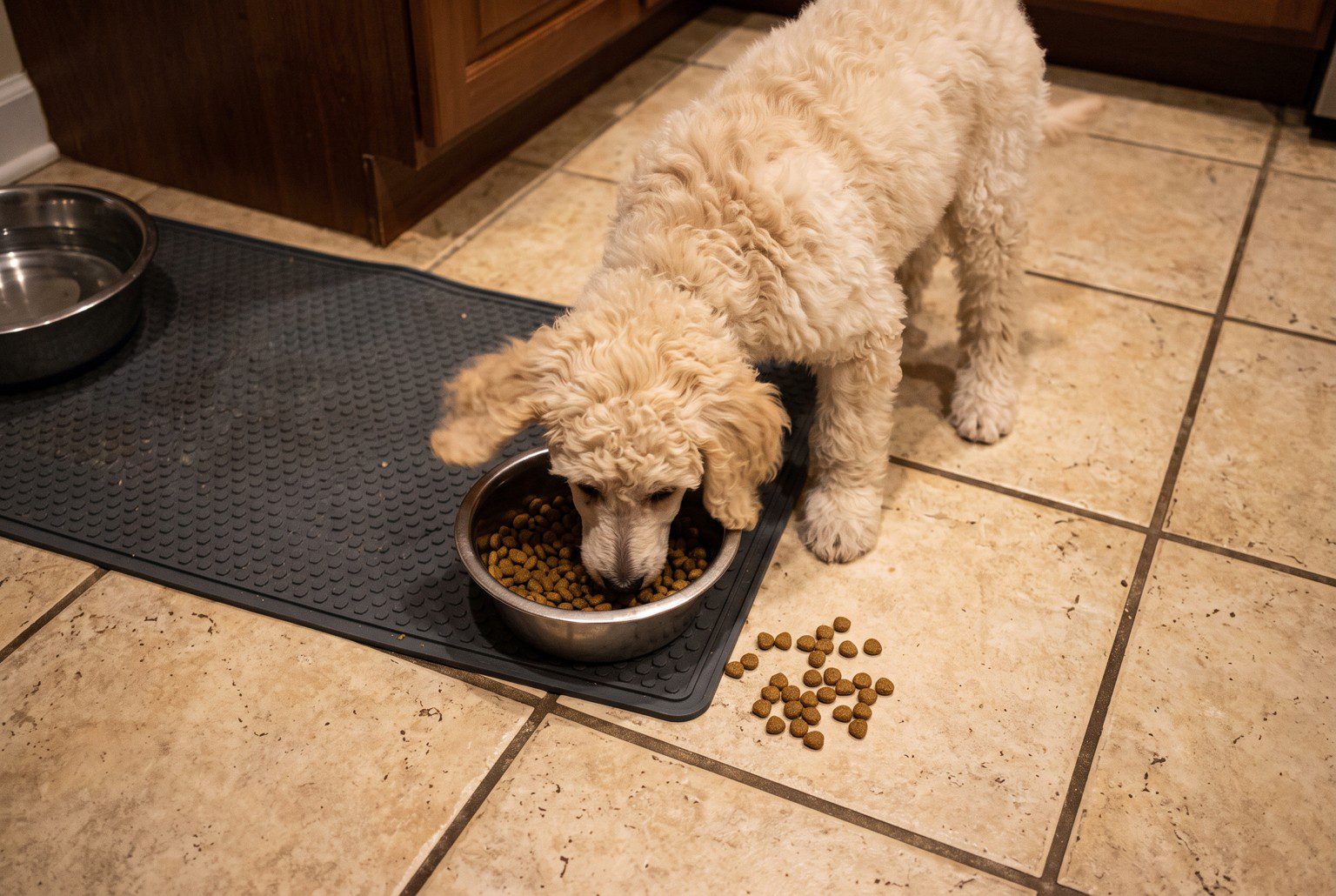
Do not free-feed. Leaving a full bowl down all day makes it impossible to notice a puppy going off his food, which is often the first sign that something is wrong. Put the bowl down, give him fifteen minutes, lift what is left.
Treats, Table Food and the Ten Percent Rule
Treats should stay under about ten percent of daily calories. Above that you unbalance a carefully formulated diet, and training treats add up faster than anyone expects.
For training, small and low-value-per-piece is what you want – you will be handing over a lot of them. Zuke’s Mini Naturals are what we use. Plain carrot, green beans and plain cooked chicken are all fine too.
Genuinely dangerous, worth knowing before you need to: grapes and raisins (kidney failure, and the toxic dose is unpredictable), xylitol, now often labelled birch sugar, which appears in sugar-free gum, some peanut butters and baked goods and causes a catastrophic blood sugar crash, chocolate, onions and garlic, macadamia nuts, and cooked bones, which splinter.
Check the label on any peanut butter before it goes in a toy. Xylitol poisoning from a “healthy” peanut butter is a genuinely common emergency, and it moves fast.
When to Switch to Adult Food
Around 12 to 15 months for a Standard Poodle – later than a small breed, because the skeleton is still finishing. There is no harm in staying on large-breed puppy food until 15 months.
Transition over seven to ten days, same as any other change.
When to Call the Vet
- Refusing food for more than 24 hours in a puppy
- Vomiting repeatedly, or any vomiting alongside lethargy
- Diarrhea lasting more than 48 hours, or any blood in it
- A distended or hard belly, especially with unproductive retching – this is an emergency, not a wait-and-see
- No weight gain across two consecutive weeks in a puppy under six months
Young puppies dehydrate quickly and have very little in reserve. What would be a wait-and-see in an adult dog is a same-day call in a nine-week-old.
What We Send Home
Every puppy leaves here with the food he is already eating, so you have one less decision in week one. Our puppies are weaned gradually and are eating solid food confidently well before they go home at eight weeks.
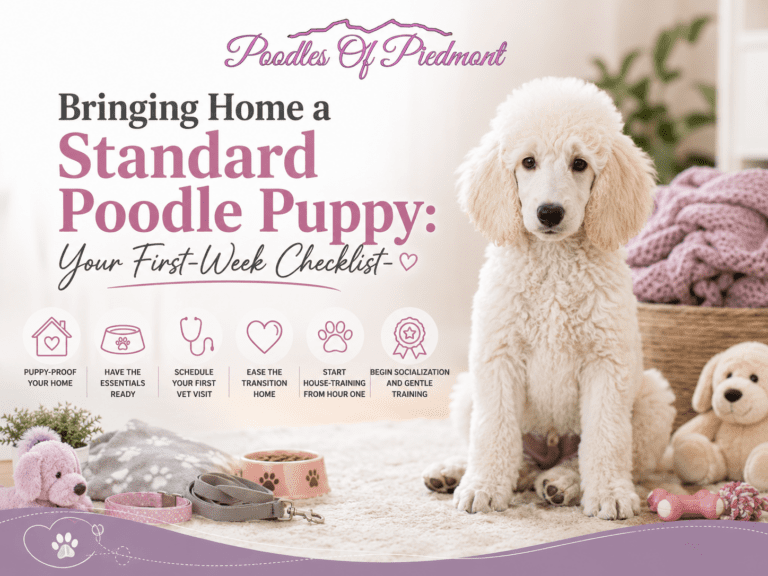
Everything we feed and use is listed on the recommended products page. The first-week checklist covers what else to have ready, and the FAQs handle the rest.
If you are three weeks in and unsure whether your puppy is the right weight, send us a photo from above and from the side. We have watched a lot of Standard Poodles grow up and we are happy to tell you what we see. Call us in Morganton at 828-870-3989, or start with the adoption application.
Ready to Find Your Perfect Standard Poodle?
Family-raised in Morganton, NC. Health-tested parents, a five-year guarantee, and AKC registration on every puppy.