
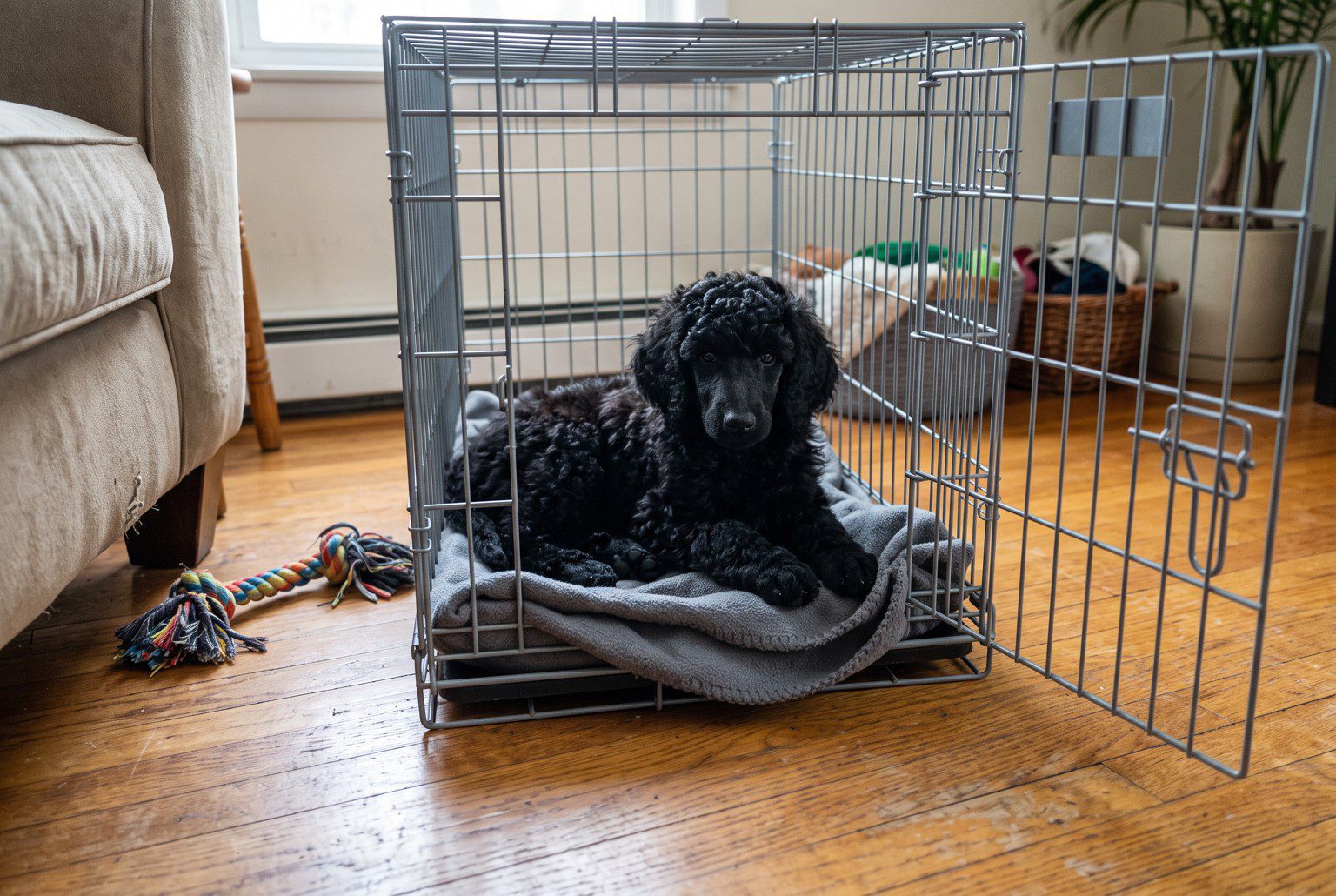
Almost every family we send a puppy home with asks about crate training, and a fair number arrive slightly apprehensive about it. The word “crate” sounds like a cage, and putting an eight-week-old puppy in a cage feels wrong.
We understand the instinct. It is also worth getting past, because a crate-trained dog has somewhere it feels safe, and that pays off for the next decade and a half – at the vet, in the car, in a hotel, during a thunderstorm, after surgery, when the house is full of relatives. A dog that has no safe space has to manage all of that on adrenaline.
Done properly, the crate is not where you put the dog. It is where the dog goes.
Choosing the Crate
As an Amazon Associate, and through other affiliate partnerships, Poodles of Piedmont earns from qualifying purchases made through the links below – at no extra cost to you.
Buy the adult size once, with a divider. A Standard Poodle finishes at 40 to 70 pounds, so you want a 48-inch crate. Buying a puppy-sized crate means buying twice.
The divider is the important part. A puppy given the run of a 48-inch crate will designate one end as a bathroom and sleep at the other, which teaches precisely the opposite of what you want. Housetraining works because a dog will not soil where it sleeps – and that only holds if the sleeping space is small enough to be all one space.
Set the divider so your puppy can stand up, turn around and lie down flat. No more. Move it out every couple of weeks as he grows. The MidWest iCrate 48-inch with divider is what we recommend and what most of our families use.
Put it somewhere central. A corner of the living room, not the laundry room or the garage. The entire point is that the crate is part of the household, and a puppy shut away alone in a distant room learns that the crate means isolation.
Week One: The Crate Is a Good Place
You are not crate training this week. You are building an association, and nothing else.
Leave the door open, all day. Toss a treat in and walk away – do not hover, do not encourage, do not make an event of it. Feed every meal inside with the door still open. Drop a chew in there occasionally so he finds it himself.
Never use it as punishment. Not once. A dog that has been shut in the crate after chewing a shoe has learned the crate is a consequence, and you will spend months undoing it.
By the end of the week most puppies wander in on their own to nap. That is the whole goal for week one.
Night One, Which Is Its Own Problem
This is worth separating out, because it is the night families dread and the one that sets the tone.
Your puppy has just left his mother and every littermate he has known. He has spent his entire life in a pile of warm bodies, and tonight there are none. He will cry. That is not manipulation and it is not a training failure – it is a genuinely distressed baby animal.
Put the crate beside your bed for the first few nights. Not across the house. Being able to hear you and smell you is the difference between mild protest and real panic, and you can drop a hand down to the crate door without getting up.
Expect to be up once or twice for potty trips. An eight-week-old bladder does not last eight hours. Take him out on the leash, to the same spot, with almost no interaction – no play, no chat, praise quietly when he goes, straight back to the crate. If night trips become entertaining, he will start requesting them.
Learn the difference between the two cries, because it matters. A rising, insistent, on-and-off bark is protest, and it settles if you wait it out. A frantic, continuous, escalating scream is distress, and waiting that one out does damage rather than teaching anything. If your puppy is genuinely panicking, get him out, settle him, and go slower tomorrow.
Most puppies are sleeping through by night five or six. The first three are the hard ones. Our first-week checklist covers what else to expect in those opening days.
Week Two: Closing the Door
Now you start building duration, in small pieces.
Feed a meal inside and close the door while he eats. Open it before he finishes. Then a chew with the door shut for two minutes while you sit nearby. Then five. Then ten with you moving around the room.
The rule that matters: let him out when he is quiet, never when he is crying. Open the door mid-cry and you have taught him, very efficiently, that crying opens doors. Poodles are clever enough to learn that in one repetition. Wait for a two-second pause, then open.
Which means you should be setting him up to succeed – short enough sessions that he is not crying in the first place. If you are regularly waiting out crying, your steps are too big.
Week Three: You Leave the Room
Same pattern, except now you go out of sight. Ten minutes, then twenty, then forty.
Vary it, and this is the part most people skip. If every crate session is followed by you leaving the house, the crate becomes a reliable predictor of abandonment and the anxiety attaches itself to the crate. Crate him while you are upstairs. Crate him while you cook dinner. Let him out and stay home. Break the pattern deliberately.
Keep departures and arrivals boring. A long emotional goodbye tells your dog that your leaving is a significant event worth worrying about. Put him in, walk out, come back, ignore him for two minutes, then say hello.
Week Four and Onward
By now most puppies settle without fuss and many take themselves off to the crate to sleep.
On timing: the usual guide is that a puppy can hold his bladder about one hour per month of age, plus one. A three-month-old manages roughly four hours in the daytime. It is a rough rule, and a sleeping puppy overnight manages considerably longer than the same puppy awake.
Four hours is a reasonable daytime maximum for a young puppy regardless of bladder. Standard Poodles are highly social and highly intelligent, and long stretches of solitary confinement suit them badly. If you work full time away from home, arrange a midday break – a neighbor, a walker, a lunchtime trip back.
When It Goes Wrong
He soils the crate. Usually the space is too big – tighten the divider. Otherwise you are leaving him too long, or he came from a background where he had no choice but to soil his bed. Our puppies are raised in the house and are used to clean sleeping spaces, which makes this much less likely.
He panics rather than protests. Frantic scrabbling, drooling, damage to the crate, injury to himself. Stop, go back several steps, and if it persists talk to your vet or a behaviorist. Separation anxiety is a real clinical condition and it does not respond to being toughed out.
He was fine and now he is not. Very common around six to nine months, when adolescence arrives and previously settled behavior comes apart. Shorten the sessions, rebuild, and be patient. It passes.
He is bored rather than anxious. A poodle is a working breed with a working brain. A dog that has not been walked or worked will not settle in a crate no matter how good your technique, and no amount of training substitutes for actual exercise. Crate a tired dog and the whole thing gets easier.
The Head Start Our Puppies Get
Sharon and I raise our litters inside the house, not in a kennel building, so our puppies arrive already used to household noise – the dishwasher, the television, doors, the vacuum. They have been handled every day since birth and have started early neurological stimulation, which is designed to build exactly the kind of stress tolerance that crate training draws on.
None of that makes the first three nights easy. It does mean you are starting from a puppy who is used to people and used to a clean sleeping space, which is a real head start.
Everything we suggest having ready before pickup day is on our recommended products page, and the FAQs answer most of the practical questions. If you are thinking about a puppy, start with the adoption application or call us at 828-870-3989 – and if you are three nights into crate training and it is not going well, call us then too. That is what we are here for.
Ready to Find Your Perfect Standard Poodle?
Family-raised in Morganton, NC. Health-tested parents, a five-year guarantee, and AKC registration on every puppy.